An agent preparing a quotation must understand a request, find the right products and use current prices. The model can interpret an incomplete email; the catalogue supplies references; rules calculate amounts. The agent coordinates the work and prepares a result the team can check.
Its value comes from that integration. The organisation defines the task, accessible tools and expected result. The following examples are proposed architectures, not client case studies or measured savings claims.
Prepare a quotation from a request
An SME receives an email listing products, quantities and a desired date. Some product names are approximate and a reference is missing. The agent first structures the request while retaining the passages that support its interpretation.
It queries the catalogue or ERP through an authorised interface. An uncertain product match remains visible in the draft instead of becoming an invented reference. Business rules calculate prices and permitted discounts, separating language interpretation from arithmetic.
The agent prepares the company’s quotation format and highlights questions for the salesperson. In this example, sending waits for approval. The reviewer sees the original request and the assumptions, with the ability to correct or reject the draft.
Tests include a complete request and a missing price, as well as ambiguous quantities and interrupted processing. The team measures correct references and the corrections required. A retry must not create two quotations.
Match payments with invoices
Swiss payment infrastructure and formats provide structured information, including QR references and ISO 20022 statements. Documents still contain exceptions such as partial payments or duplicated invoices.
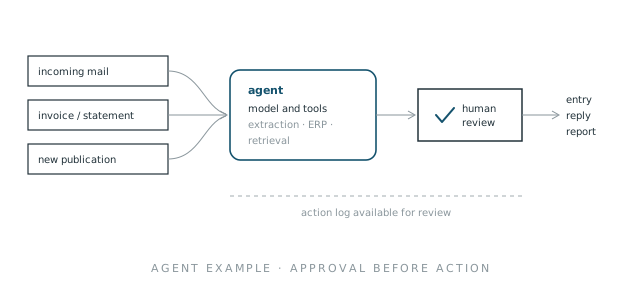
An agent can connect those documents with the accounting system. Exact matches use deterministic rules. A model can help interpret an unstructured attachment or explain a difference. Each proposal retains references to the material used.
The result is a proposed reconciliation with its exceptions. The accountant reviews ambiguous cases and approves the intended entries. Preparation remains separate from authority to release a payment.
Tests cover partial payments and missing references, and check that repeating the process cannot create another entry for the same document. SIX QR-bill documentation provides part of the format context; the software must also respect the selected banking-format versions.
Route a municipality’s incoming mail
The agent identifies a request, retrieves authorised material and proposes the responsible department. It can prepare a draft answer with source references.
Access follows the role handling the case. A model’s ability to find information does not authorise it to read every municipal record. The search and tools enforce the boundary before content reaches the model.
The responsible service approves routing and the answer. Tests include a request for another department, a superseded rule and a document containing an instruction intended to mislead the agent. Received content must not expand its permissions.
Prepare verifiable research monitoring
An institute defines topics and selection criteria. The agent searches the chosen catalogues and prepares a synthesis of relevant work. A structured bibliography lets researchers find the papers and their versions.
The synthesis distinguishes the study’s purpose and method from its reported findings. Missing information in an abstract does not become a conclusion about the full paper. If the full text is unavailable, the limitation must be visible.
Researchers check the references and relevance. A known collection of papers can reveal omissions, while sampling the summaries checks their accuracy. Evaluation concerns selection as well as writing.
Evaluate the complete workflow
Each result must remain connected to its data and actions. Tools receive limited permissions. Instructions are versioned and tested when they change. Logs retain useful evidence under appropriate content and retention rules.
| Workflow | Expected result | Decisive check |
|---|---|---|
| Quotation | Draft based on the current catalogue | References, amounts and missing information |
| Accounting | Explainable matches and exceptions | Source documents and absence of duplicates |
| Municipal mail | Proposed routing and reply | Responsible service, sources and access |
| Research monitoring | Selection and synthesis | Exact references, relevance and source limitations |
The team tests shutdown and recovery, including removal of access. Autonomy can then evolve according to results and the consequences of error. A useful human review gives the person access to the evidence and enough time and authority to correct the proposal.
These criteria show whether an agent adds an operational capability. The article on retrieval, verification and orchestration develops the architecture connecting those steps.